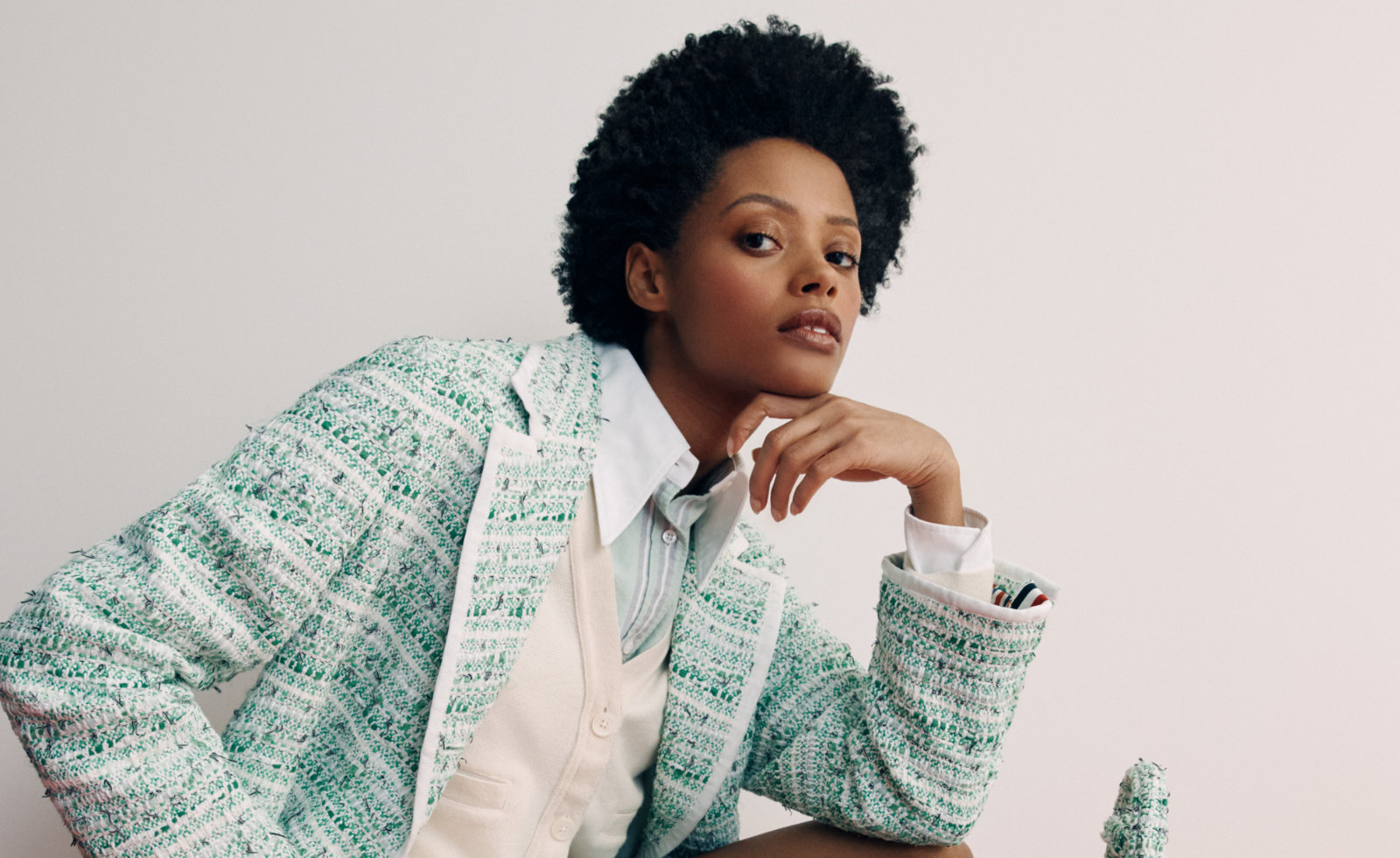
The winner of Britain’s Next Top Model has been announced as Alex Evans, 18, of Cranleigh, Surrey, after winning against Catherine Thomas, also 18, in the Cape Town-set finalé.
Stefanie Wilson, 22, came third.
Miss Evans takes home a contract with Models 1 and appear in a £100,000 campaign for Max Factor. She will also appear in a cover photo shoot with Company.
She says, ‘Never in my wildest dreams did I ever think I could achieve anything like this … but now I have proved myself wrong.’
The 14 contestants in the reality show’s fourth series on Living TV were coached by experts including Zandra Rhodes. Judges included Lisa Snowdon, photographer Huggy Ragnarsson and stylist Gerry DeVeaux.
Miss Evans had plans to become a journalist if she had not been successful in modelling. She recently completed her A levels and is waiting for the results.
July 7 marks the anniversary of the passing of our friend Colin Morley, who was killed in the 7-7 terrorist bombings in London three years ago. Since then we’ve tried to keep Colin’s memory alive by giving an award named for him at the Medinge Group, for the best branded non-profit organization. My wishes go out to Ros and their children: Colin remains a great influence with his kindness, generosity and expertise.
Preliminaries for Miss Universe began Sunday, where the contestants model in their bikinis; and the interviews on Monday are three minutes long, with three judges.
This surprises me, because we interviewed the contestants in New Zealand over a minimum of 10 minutes with five judges—and I dare say, though I never timed the sessions, that we might well have hit 15 minutes in some cases.
I do know that the meet-and-greet and interviews took us well into 11 p.m. this year and midnight last year.
It’s certainly harder for judges to know the candidates based on a cursory interview, but I imagine with a larger group of girls, time is more limited.
Samantha Powell, Miss New Zealand 2008, will have less time to wow the judges in a three-minute pitch, which in some respects goes against the more relaxed way New Zealanders, in general, conduct even business meetings. It’s not about the pitch, but getting to know someone.
Nevertheless, every contestant is on an equal footing.
What we tried to do was find someone who could remain confident regardless of the situation, and I think Sam—who can think well on her feet—was the right choice.
Reading her email back home, details of which I won’t reveal for privacy, Sam isn’t fazed and she will do well for Aotearoa.
I’m sure readers in New Zealand join me in wishing her well as the competition kicks into high gear—with the major presentation show on Wednesday. Good luck, Sam!
As reported earlier, Kylie Minogue has been to Buckingham Palace to collect her OBE, which was presented by HRH Prince Charles.
Minogue arrived in a chauffeured limousine and had chatted and joked with the Prince during the investiture. She wore a cream dress with gold high heels.
Attending in support of the Australian-born singer were her parents and her sister Dannii, who had rushed from the filming of The X Factor.
Minogue said, ‘It was surprisingly emotional. I expected to be a little nervous, obviously very excited, but it was very emotional seeing all these people from different walks of life joining together for this event.’
Her OBE was awarded for services to entertainment by HM Queen Elizabeth II as part of her New Year’s Honours.
[Cross-posted] In the spirit of July 4, I thought it would be interesting to explore the idea of the United States retaining its influence in the 21st century.
What many see is dire. Beyond the anti-war types’ opposition to the War on Terror, there are corruptinstitutions, political and corporate, impeding progress on so many things, from innovations to ways society can function more progressively. The same institutions have led to a financial crisis. Economic management has led to a weak dollar, to the point where some reject it for the euro.
So with the rise of India, and less so of Red China, where is the United States in all of this? How can I be so bold as to say it will remain the American century?
Because of Americans. Individuals. Those who have access to their own speaking platforms, highlighting what they see is wrong with their country, and having a nation that protects their free speech as sacrosanct.
The country that has championed individuality may well be saved, karmically, by individuals themselves.
No anti-American I know stands firmly in his or her country and disses individual Americans. They spit their venom at the government or their corporations. The Iranian blogs that I visited, to see where their root cause of anti-Americanism lay, targeted abuse through globalization. Maybe they have a point, because Americans themselves are not too happy about outsourcing. On one point their opinions do not differ much.
And because many Americans have the skills to put their words across, in what remains the internet’s lingua franca—English—and because they can identify the sources of their problems, they can address them.
What we, in the rest of the world should be doing, is engaging this dialogue. Putting forth our point of view.
It’s frightfully easy for people to either have a case of nation envy or tall poppies, dragging down the richest country on earth and pointing out its problems for a short-term feeling of superiority. This is childish at best. While I do not deny the US has its faults—and Americans themselves would be the first to admit that—we should give each other perspective.
I talk about our healthcare system: not the best in the world, but I would rather be sick here than in the US, because of universal coverage. And if we chat to our friends in the US about this, it will give them ideas on how they might accomplish it—or avoid it, if they see faults in our model. The idea of the internet is a beautiful one, even if spammers and pornographers threaten its sanctity: the ability to have a small world where we can have one-on-one discourses, and better ourselves.
That free speech has to be defended at all costs, because even if the United States restricts the movement of people and the movement of capital, it needs to at least allow the movement of ideas.
It is something to be guarded jealously and taught in its schools.
It is, meanwhile, denied to many in Red China, unable to grow through dialogue. Instead its economy grows from the influx of capital, going in on growth figures that have been verified by none except a communist dictatorship, or from the misappropriation of intellectual property. Red China understands the latter cannot continue and has put up some restrictions—but until the opportunities for growth are open to all, then it will not have the support of its citizenry in the way the United States does. Red China can only become a great nation if all of China rethinks the republic, perhaps a commonwealth, but certainly one based around the principles of Confucius and Sun Yat-sen. It can happen as suddenly as the collapse of the Soviet Union, or it may take many more years than we imagine.
Till then, the nation that may yet benefit is one that has great dialogue with the United States, and embraces it, seeing it as a blending of cultures and an opportunity for growth.
That nation is India and while its opportunities have not flowed through to everyone, and it, too, has its internal problems, it is poised to rise through the freedom of people, capital and ideas. The Indian century may follow the American century, but it may take a familiar form. Not far from now, if current trends continue, the Indian middle class will grow. It will form the basis of a strong national infrastructure. And the Indian century, too, will be based around freedom and liberty.
However, in the immediate term, provided the United States can unite itself around its real values, those principles that, in reality, are not uniquely American after all, I see no reason for the American century not to continue.
It is fortunate to have a holiday like the Fourth of July, a chance to remind everyone that freedom and justice are not buzzwords. That these principles really do mean something to the rest of the world—and that they need to be honoured. And that the power rests with everyone, because everyone has a voice.
We seldom focus on a single product in the print editions’ beauty pages, unless it’s a special promotion on behalf of a client in an advertorial. But we couldn’t pass up these beautiful visuals for one of the products we are featuring in the next Lucire in New Zealand, the Flash Radiance Skincare Brush from Yves Saint Laurent Beauté.
It’s a NZ$95 brush applicator designed to highlight and it’s also meant to make the wearer feel refreshed and moisturized.
The images feature YSL make-up artistic adviser Val Garland and Richmond, British Columbian model Coco Rocha.
Singer Kylie Minogue, 40, who was awarded an OBE by HM Queen Elizabeth II in the New Year Honours’ List, is due to be invested at Buckingham Palace’s grand ballroom today.
With HM the Queen in Scotland, the presentations will be done by HRH the Prince of Wales.
Minogue already has the Order of Arts and Letters from France, which she collected in May.
This is looking magnificent. I saw the last Bond film a day after its world première, in Los Angeles, and put some more money to the Broccoli family’s coffers by seeing it a second time when it débuted in New Zealand—then bought the DVD. So no surprise when I say I am looking forward to the Marc Forster-directed Quantum of Solace. It even has an Ian Fleming title, even if it has zero connection to the original short story and the W. Somerset Maugham-style dinner party setting. Now watch for the extra footage, the Eon Productions’ machine’s hype and the gradual build-up to get the next Bond movie into our consciousness.
As some of you may have expected, the media are analysing why Kazakh model Ruslana Korshunova committed suicide. Part of it is because the analysis keeps the story alive. Another part is because people are fascinated by this fashion world, and why shouldn’t a newspaper, normally covering dull stories, have an excuse to put the late Miss Korshunova’s face in its pages? (New York even thinks New York might have killed her. Other media are, as I predicted, attempting exposés on the cruelty of the modelling world, such as The Scotsman.)
I suppose I am doing the same thing, by critiquing the fourth estate and having an excuse to publish her name again. But perhaps we will refrain from posting an image of her in this post: this little opinion is not about beautifying a page to get some extra eyeballs.
I don’t know anyone who had unsuccessfully attempted suicide well. I met one woman who had survived slitting her wrists, but it was a verboten topic so I never raised it. I do know a friend who succeeded in his attempt in my university days.
No one, not even his closest friend, David, knew that Andrew was depressed or confused before he took his life with a shotgun in the early 1990s.
It unleashed a whole bunch of emotions with us, his friends, from sadness to downright anger. And knowing Andrew, the ever-alert cynic that he was, he might have had a chuckle at us, if there is an afterlife. (Then again, he didn’t think there was.)
But his decision remains a mystery after nearly 17 years.
And that is probably the folly of trying to rationalize why Ruslana Korshunova leapt to her death out of a ninth-storey window in New York’s Financial District last Saturday.
Anyone who rationalizes the action of suicide probably wouldn’t be committing suicide—because rationality says there are ways out, there are family members left behind who are hurting, and that there is always some hope. There are exceptions: it is possible that a very rational person sees no exit to their situation.
Suicide is, from my layman’s point-of-view (one which I am prepared to be corrected on), something usually irrational, and trying to judge Miss Korshunova’s last few months on earth through her blog postings won’t tell us too much. The Daily Mail tabloid in the UK speculates that there were relationship woes for her, while friends report that they saw nothing that would cause her to take her own life.
Yet the rational part of me tells me that even at age 20, no relationship wound is deep enough for suicide. Heartache, yes. Even emotional turmoil for a period.
Why Ruslana Korshunova leapt out of her window on Saturday will probably be a mystery to all of us, not least her family who had to identify her body this week.
Perhaps we should stop speculating. ‘Why?’ is a very powerful question in newsmedia and we are always desperate for answers, but in some cases, such as suicide, it may be futile to seek them out. We should let the Korshunova family grieve privately.